Younger and Younger Intangible Heritage —— Observation on the First Annual Conference of Intangible Heritage Protection in China
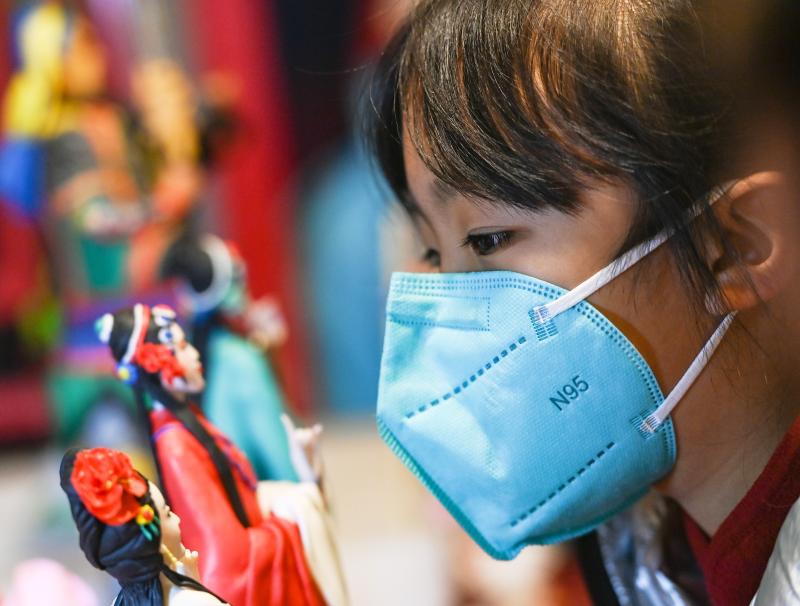
A little tourist stopped in front of the booth of Cao Zhou Noodle in the non-legacy collection. Xinhua News Agency reporter Zou Jingyi photo
Xinhua News Agency, Xi ‘an, February 19th (Reporter Cai Xinyi, Zou Jingyi) The first annual conference on the protection of China’s intangible cultural heritage is being held in Yulin, Shaanxi Province. More than 200 intangible cultural heritages and more than 500 non-genetic inheritors use ingenuity and ingenuity to jointly show the value of intangible culture in the times.
In recent years, a large number of inheritors and enterprises have re-created intangible cultural heritage with modern aesthetics, which has narrowed the distance between people and intangible cultural heritage with cultural derivatives.
Tian Sheng, the representative inheritor of New Year Pictures in Jiaonan, was surrounded by visitors at the first annual China Intangible Heritage Protection Conference. "In recent years, we have extracted the characteristic elements of Jiaonan New Year pictures and made them into daily necessities, which are very popular in the market." Tian Sheng picked up a tea set and displayed it. The sowing and harvesting scenes depicted in the colorful New Year pictures added agility and vitality to the cyan porcelain.
Jiaonan New Year Picture is a Qingdao-level intangible cultural heritage project, which follows the characteristics of folk New Year Pictures, draws lessons from and absorbs artistic features such as China meticulous painting and folk paper-cutting, and gradually evolves into an artistic style with full composition, color jumping, simple and exaggerated modeling, and the wenchuang products made of the elements of New Year Pictures are exquisite and lovely.
Tian Sheng believes that only by integrating into the atmosphere of the times and entering daily life can the intangible charm be perceived and the skills be passed down from generation to generation.
In the view of Chai Zhanzhu, a 58-year-old representative inheritor of national-level non-legacy twisted tire porcelain, the vitality of non-legacy lies in technological innovation.
Twisted-tire porcelain originated from Dangyangyu Kiln in the Northern Song Dynasty. It is made of two or more kinds of porcelain mud with different colors, woven and baked with a unique twisted-tire technique.
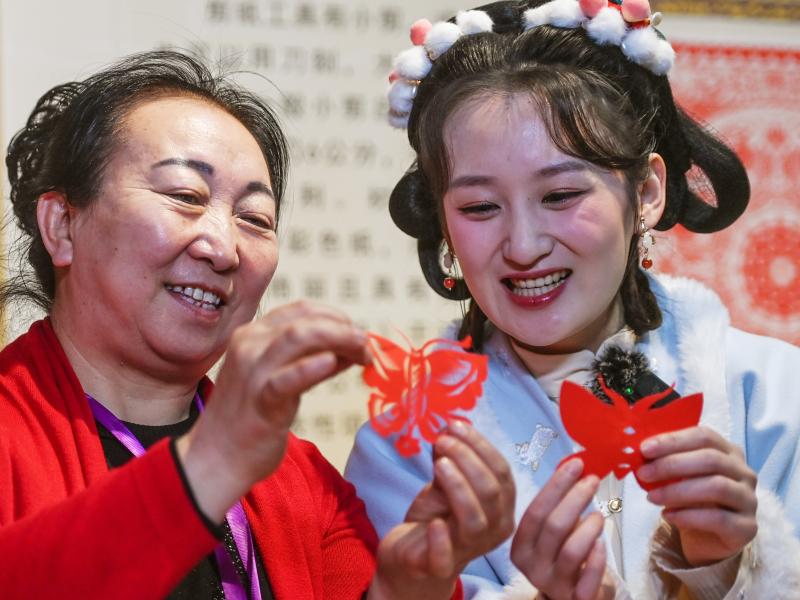
Chen Yanfen (left), a non-genetic inheritor, is showing paper-cutting. Xinhua News Agency reporter Zou Jingyi photo
Chai Zhanzhu has been engaged in porcelain making for more than 30 years, and has experienced the reburning and revival of twisted-tire porcelain. "To carry forward the skills, we must work hard on innovation." Chai Zhanzhu said, "In the past, there were only feather patterns, mat patterns, chrysanthemum patterns and other decorative patterns in the twisted-tire porcelain. Now, landscapes, figures, flowers and birds can be woven into the porcelain by the twisted-tire production process. We have also cooperated with Henan Polytechnic University, Zhengzhou University and other universities to upgrade the clay formula and glaze formula, and have obtained many patents. "
According to Chai Zhanzhu, at present, there are six enterprises, one professional cooperative and more than 20 family workshops engaged in the production, processing, sales and technological research of twisted-tire porcelain products in Dangyangyu Village, with an annual sales of about 300,000 pieces (sets) of ceramics.
In recent years, young inheritors are becoming the main force in the inheritance and dissemination of intangible culture on short video and live broadcast platforms.
Chang Yangyang, the representative inheritor of Mengjin Paper-cutting, a provincial intangible cultural heritage project, opened an account in Tik Tok. From the beginning, he released a paper-cutting video and only got one or twenty praises. By a live broadcast, he attracted more than 1,000 fans, and now he has 340,000 fans. He constantly demonstrated paper-cutting skills and explained paper-cutting culture on social platforms.
"Young people are very interested in traditional culture, and social networks just build a bridge between them." Chang Yangyang said.