Linkage and interaction drive
The core area of China Agricultural Park-Chaotian Pingxi Modern Agricultural Park Jiange Hanyang Modern Agriculture Zone —— Enlightenment from the construction of modern agricultural park in Guangyuan.
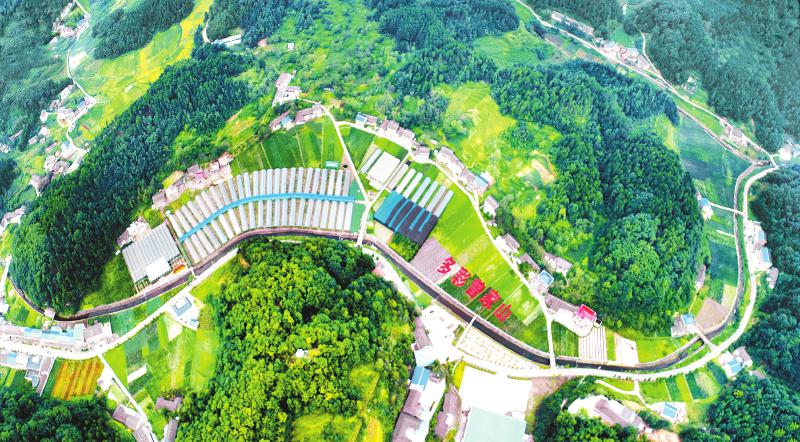
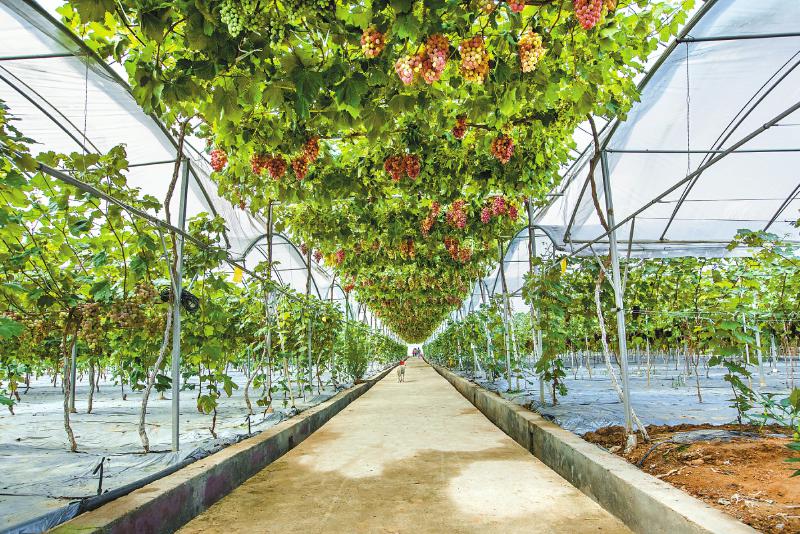
In 10 years, 100 modern agricultural parks will be built, with a core area of 1.03 million mu, including 7 provincial-level modern agricultural demonstration parks and one county as a whole, which will become a national modern agricultural demonstration zone, a national modern agricultural industrial park and the first batch of advantageous agricultural products with China characteristics. This is the report card handed over by Guangyuan Development Modern Agricultural Park.
How to develop modern agriculture is a difficult problem for mountainous areas. Guangyuan, located in the northern part of the mountainous area around the basin, has created a "mountain road" to develop modern agriculture in mountainous areas: large, medium and small parks are linked, the first, second and third industries are interactive, and new and special products are driven, so that ecological green agricultural products in mountainous areas can "go out of the mountain" and "go out to sea" and farmers in mountainous areas can increase production and income.
How to build the park?
With big and small, large, medium and small parks are linked.
There are more flat dams in mountainous areas, more manual work and less mechanical farming, and more traditional crops and less cash crops. Facing the present situation of "three more and three less", how should Guangyuan modern agricultural park be built?
Guangyuan Municipal Committee proposed to develop clusters with large areas and small areas. That is to say, taking the modern agricultural park as the leader, the village characteristic industrial demonstration park and the household characteristic industrial park will be built simultaneously, forming a linkage pattern of "three parks" and inciting capital investment from all walks of life.
In 2008, Guangyuan took the lead in starting the construction of modern agricultural parks in the province, and has experienced two rounds of continuous construction so far. In the first round (2008-2012), we focused on modern science and technology demonstration, factor integration demonstration, mechanism innovation demonstration and scale benefit demonstration, and explored and formed the construction experience of "overall planning, establishing dominance, integrating funds, assembling and supporting, slicing into strips, and stepping forward", and built 50 modern agricultural demonstration parks with 520,000 mu of advantageous and characteristic industrial bases.
In the second round (from 2013 to now), Guangyuan Municipal Party Committee and Municipal Government took the construction of modern agricultural park as the comprehensive carrier and the main grasper, and implemented the "five-in-one" comprehensive construction of infrastructure, industrial development, new village construction, public services and grassroots organizations to further improve the development level of the park.
After more than 10 years of unremitting efforts, Guangyuan City has built 100 modern agricultural parks, which have been named and awarded by the municipal government in ten batches. Cangxi County has been established as a national modern agricultural demonstration zone, a national modern agricultural industrial park and the first batch of advantageous agricultural products with China characteristics. Seven parks, namely Wangcang Sanhe, Cangxi Sanhui, Chaotian Neutron, Zhaohua Baian, Cangxi Qinglong, Jiange Chaoshou and Qingchuan Bailong Lake Happiness Island, have become provincial-level modern agricultural demonstration parks.
The "three parks" are linked to form a "triple effect". The "networking effect" of infrastructure construction. Join households in the park, build convenient main roads, secondary roads and tractor roads and blacken and harden them to form a "road network" in the park; Combining water storage with pumping, supporting production facilities such as reservoirs, water supply and drainage channels, and spraying and drip irrigation to ensure the production, living and ecological water use of farmers in the park and form a "water network" in the park; Adjust the field type, level the land, improve the fertility, build 560,000 mu of high-standard farmland, and form a "field net" in the park.
The "resonance effect" of new village construction. According to the principle of "small-scale, group-style, micro-pastoral and ecological", combined with ex situ poverty alleviation and rural complex construction, 1,572 happy and beautiful new villages with "seeing mountains, seeing water and remembering to live in homesickness" will be built, with 100% coverage of new villages in the park, integrated production and villages, and garden villages will resonate.
The "long arm effect" of public services. The park has explored and established industrial party organizations, community party branches and cooperative party branches across villages and townships, and built 67 "1+N" village-level social service centers, 244 cultural leisure and tourism nodes, 16 tourist reception centers and 60 agricultural and agricultural products supermarkets. The people in the park are generally within the "long arm of service" of a 20-minute journey.
What about the industry?
"Agriculture+"integration, interaction between the first, second and third industries
After the park is built, it is not easy to "pack what". Guangyuan Modern Agricultural Park has made great efforts in industrial development by holding on to "mountain products" and "native goods". At the end of July, the Seventh Plenary Session of the Seventh session of Guangyuan Municipal Committee was further clarified, focusing on the development of six leading industries with high quality grain and oil, ecological livestock and poultry aquatic products, alpine green fruits and vegetables, special delicacies, selenium-rich and zinc-rich tea and authentic Chinese herbal medicines, and making great efforts to build seven industrial chains of red-hearted kiwifruit, walnut, authentic Chinese herbal medicines, olive, selenium-rich and zinc-rich tea, Jianmenguan chicken and ecological raw pork, cattle and sheep.
Specific to the parks, there are 100 large parks, including 6 high-quality grain and oil parks, 17 kiwifruit parks, 10 woody oil parks, 9 characteristic mountain delicacies parks, 15 tea and tobacco parks, 16 animal husbandry and aquaculture parks, 14 green vegetables parks, 8 Chinese herbal medicines and small fruits parks, and 5 leisure agriculture parks.
Big parks should form big industries. Guangyuan has built the largest production base of red-heart kiwifruit and yellow tea in China, an important production base of woody oil and green tea in western China, and an important production base of green vegetables, native chickens, Chinese herbal medicines, meat, cattle and sheep in Sichuan.
Big industry does not mean strong industry. How to improve the output value? Promote industry through agriculture, and form an industrial chain through interaction between primary, secondary and tertiary industries. A city leader vividly said that modern agricultural parks should boldly go out and marry to form a "agriculture+"family with industrial integration.
The interaction between the first, second and third industries and the integration of the seven industrial chains have shown initial results.
It has cultivated new kinetic energy for agricultural and rural development. Promote the integration of agriculture and animal husbandry, agriculture and forestry, and grain economy, and accelerate the adjustment of agricultural structure; Supporting cold chain logistics, drying facilities, agricultural products wholesale markets, etc., extending the industrial chain; Implement the "7211" leisure agriculture construction action (building 7 national agricultural parks, 20 provincial agricultural parks, 100 leisure agriculture demonstration villages and 1000 leisure farms) to promote the integrated development of agriculture, tourism and culture; Accelerate the application of agricultural Internet of Things technology, vigorously develop rural e-commerce, and promote the integration of new technologies … New industries and new formats are presented one after another, adding new momentum to agricultural development.
It has strengthened the main body of modern agricultural management. Cultivate 27,000 new professional farmers in the park, develop 760 farmers’ cooperatives, 1,120 family farms and 14,600 large-scale breeders in the park, cultivate 2 national leading enterprises, 50 provincial and municipal leading enterprises, build 48 agricultural socialized service supermarkets, and develop 128 specialized socialized service organizations such as animal and plant disease prevention and control, quality and safety, seedling breeding, green plant protection and agricultural machinery services.
It gave birth to a new model of modern agricultural management. Through policy guidance and project support, the land transfer in the park will be promoted in an orderly manner, and farmers’ contracted land will be transferred to new agricultural business entities such as large professional households, family farms, farmers’ cooperatives and agricultural enterprises, and the scale of land management in the park will reach 98%. We have implemented a new mechanism for linking the interests of business entities and farmers, such as guaranteed income, dividends paid by shares, and profit return, and innovated production and operation methods, such as trusteeship, "enclave" poverty alleviation, quantitative equity of financial funds for supporting agriculture, and joint venture of land conversion.
How to get to the market?
Do a good job of brand, driven by new and excellent products
What is the purpose of building a modern agricultural park?
Deepen the structural reform on the supply side of agriculture and promote the transformation and upgrading of agriculture. Guangyuan Modern Agricultural Park aims at six characteristic industries (high-quality grain and oil, ecological livestock and poultry aquatic products, alpine green fruits and vegetables, characteristic delicacies, selenium-rich and zinc-rich tea, and authentic Chinese herbal medicines), specializing in "ecology" and "organic". In a word, do a good job of "green" brand and make a fuss about the "new and excellent" products.
"New and special" broke into the market, and Guangyuan played "three cards".
Focusing on scientific and technological services, playing a good technical card. Deepen the cooperation between municipal schools, departments and cities, and successively establish close cooperative relations with more than 20 scientific research institutes such as Sichuan Agricultural University, China Academy of Agricultural Sciences, Tea Research Institute, Vegetable Research Institute and Institute of Botany, Chinese Academy of Sciences, set up a technical innovation service team in the park, and carry out key technical cooperation research such as kiwifruit variety selection, ulcer control, yellow tea adaptive cultivation, walnut multi-head high-grafting and cold chain logistics. A number of new technologies, such as low-carbon recycling cultivation, green organic cultivation, labor-saving cultivation, Internet of Things, commercialization and so on, have been integrated and innovated. The popularization rate of improved varieties in the park is 100%, and the promotion of advanced technologies is over 90%. The degree of mechanization and intelligence in the park has been continuously improved.
Focus on improving quality and efficiency, and lay a good ecological card. Popularize the breeding cycle mode of pig biogas fruit, chicken biogas tea, mushroom biogas forest, fruit grass livestock, rice shrimp, rice fish, etc., reduce the use of chemical fertilizers and pesticides, reduce pollution emissions, and let "ecology", "organic" and "green" run through every link from the field to the table.
Focus on the mid-to high-end market and lay a good quality card. We will promote the full coverage of the intelligent supervision on the quality and safety of agricultural products in the park, take the park as a gathering area, promote the certification of 338 "three products and one standard" agricultural products in the city, and build a production base of 1.66 million mu in the national green food raw material standard area. We will build a standard system for the production, storage and marketing of characteristic industries, formulate and improve 62 local standards in Sichuan Province (Guangyuan City), and build 63 national and provincial agricultural standardization demonstration zones.
"Three cards" consolidated the "green" brand, won market respect and promoted farmers’ income. At present, the annual output value of Guangyuan Modern Agricultural Park has exceeded 10 billion yuan, and the per capita industrial net income of farmers in the park has reached 7,000 yuan. With the addition of land transfer rent income, income from labor services in the park, contracted land shares and quantified share income from financial funds, the per capita disposable income of farmers in the park has reached 13,500 yuan, which is more than 3,000 yuan higher than that of non-park farmers.
The construction of modern agricultural park in Guangyuan not only bears the heavy responsibility of promoting high-quality economic development, but also faces the opportunity of poverty alleviation and rural revitalization. The Seventh Plenary Session of the Seventh Session of Guangyuan Municipal Committee put forward that we will continue to upgrade and build a number of agricultural industrial parks with modern characteristics with high production level, wide application of "internet plus", good product sales, perfect system and mechanism, close interest linkage, social capital participation and strong financial support.