What is the import and export in February? These data tell you
On March 8, the latest foreign trade data of the General Administration of Customs was released. Many people couldn’t help but gasp when they saw the import and export data in February, especially the export data: Wow! Exports fell by 16.6%! This also got? Look at the impact of this economic and trade friction!
As for the second half of the sentence "excluding the Spring Festival factor", some people didn’t read it at all, and some people might think: Not really? The Spring Festival is held every year. Will it have such a big impact?
In February, China’s total import and export value was 1.81 trillion yuan, down 9.4%. Among them, exports were 922.76 billion yuan, down 16.6%; Imports were 888.3 billion yuan, down by 0.3%; The trade surplus was 34.46 billion yuan, narrowing by 84%. Excluding the Spring Festival, China’s import and export, export and import increased by 10.2%, 7.8% and 12.9% respectively in February.
What is the import and export situation? Only by analyzing the market and observing it from multiple dimensions can it be closer to the truth.
It is obviously unfair to just touch the elephant’s teeth and ears and get that the elephant looks like a radish or a dustpan.
Let the data speak for themselves.
1. What is the Spring Festival effect?
(It’s not what you think, a seven-day holiday)
As far as foreign trade exports are concerned, under normal circumstances, foreign trade enterprises will expand their exports before the Spring Festival and reduce their exports after the Spring Festival, so whether the Spring Festival occurs in January or February will often directly affect the export rhythm.
The export data of the General Administration of Customs in the first two months of 2010-2019 can just confirm this rule (see the table below).
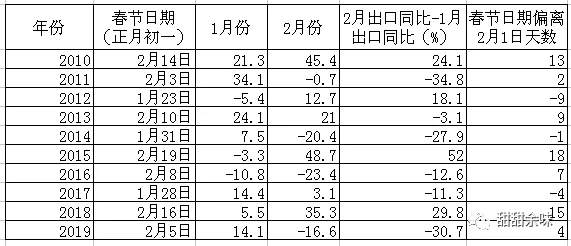
According to the above table, the analysis chart of the influence of the Spring Festival effect on the export distribution in January and February is as follows:
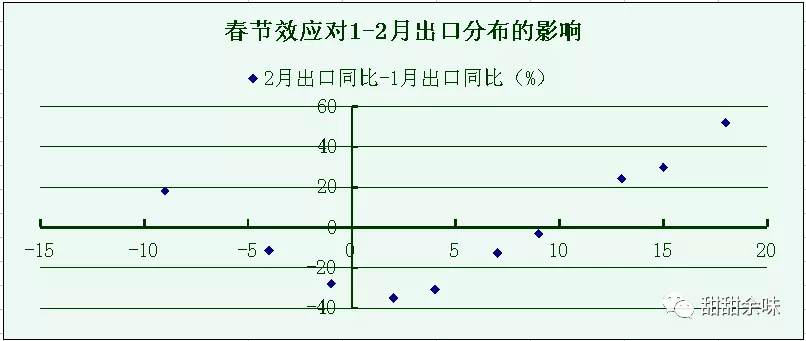
(Note: The horizontal axis in the figure shows the number of days when the Spring Festival deviates from February 1st, and it is positive after February 1st and negative before, for example, February 5th is 4, and January 23rd is-9; The vertical axis represents the difference between the year-on-year growth of exports in February and January — — The greater the difference, the better the export growth in February than in January. )
As shown in the above figure: When the Spring Festival falls after February 1st, the more the date of the Spring Festival deviates from February 1st, for example, in the middle of February or even later, the more the export progress deviates to February, in other words, the exports will not all flock to January;
When the Spring Festival is before February 1, the more the date of the Spring Festival deviates from February 1, for example, if it is now more than January 20 or even earlier, the more the export progress deviates to January, in other words, the exports in the first two months will be more concentrated in January.
This year’s Spring Festival is in early February (February 5), so the expansion of exports before the festival basically fell to January;
Last year’s Spring Festival was in mid-February (February 16th), and the expansion of exports before the festival mainly fell in February.
In fact, when the General Administration of Customs released the import and export data in January this year, some analysts pointed out that due to the "wrong month" effect of the Spring Festival, enterprises rushed to export before the holiday, so the export data performed well in January, while the export in February may be significantly negative. Now it seems that it is true. This is why the customs data points out: "Excluding the Spring Festival factor, China’s import and export, export and import increased by 10.2%, 7.8% and 12.9% respectively in February."
Except America, other major markets are not bad.
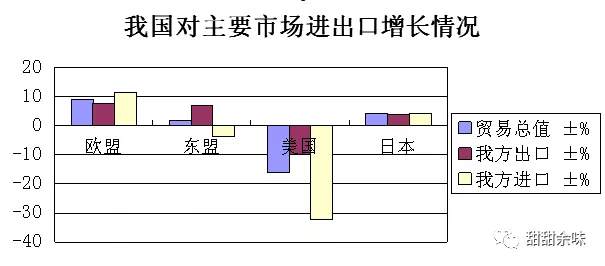
According to the data of the General Administration of Customs, several major markets, except for the obvious decline in the total trade value between China and the United States, have generally rebounded with the European Union, ASEAN and Japan. The total trade value with the European Union and ASEAN accounted for 16.2% and 12.8% of China’s total foreign trade value respectively, both exceeding the total trade value between China and the United States by 11.6%.
It is particularly worth mentioning that in the same period, China’s total import and export to countries along the "Belt and Road" was 1.28 trillion yuan, an increase of 2.4%, which was 1.7 percentage points higher than the overall national growth rate and accounted for 28.2% of China’s total foreign trade.
Behind these data, there is not only the influence of Sino-US economic and trade friction, but also shows that China’s import and export structure can be flexibly adjusted under the changes of internal and external environment, showing considerable economic resilience.
3. Private enterprises become a new force.
Another exciting thing is that the import and export of private enterprises are showing more and more vitality:
According to this data, in the first two months, the import and export of private enterprises was 1.84 trillion yuan, up 4.4%, accounting for 40.6% of China’s total foreign trade, up 1.4 percentage points over the same period last year.
Looking ahead (according to the data released by the General Administration of Customs):
In 2018, the import and export of private enterprises in China was 12.1 trillion yuan, up 12.9%, accounting for 39.7% of China’s total import and export value, up 1.1 percentage points from 2017.
In the first 10 months of 2018, the import and export of private enterprises was 9.88 trillion yuan, up 14.6%, accounting for 39.4% of China’s total foreign trade, up 1.1 percentage points over the same period last year.
In the first four months of 2018, the import and export of private enterprises was 3.52 trillion yuan, an increase of 12.4%, accounting for 38.6% of China’s total foreign trade, an increase of 1.2 percentage points over the same period last year.
In 2017, the import and export of private enterprises in China was 10.7 trillion yuan, up 15.3%, accounting for 38.5% of China’s total import and export value, up 0.4 percentage points from 2016.
In 2016, the import and export of private enterprises in China was 9.28 trillion yuan, an increase of 2.2%, accounting for 38.1% of China’s total foreign trade.

Is the slow and steady rising curve particularly gratifying to people?
More and more powerful private enterprises, come on!
4. The import and export of all kinds of commodities are mixed.
In terms of exports, mechanical and electrical products accounted for the bulk (58.3%), while the exports of clothing and footwear decreased by 10.2% and 6.9% respectively, while toys and plastic products increased by 16.6% and 6.2% respectively. Steel exports increased significantly.
On the import side, the demand for energy is still expanding: the imports of natural gas, crude oil, refined oil and coal have increased by 18.5%, 12.4%, 4.4% and 3.8% from high to low, which may indicate that domestic demand is gradually picking up. Imports of iron ore, steel products, integrated circuits and automobiles decreased by 5.5%, 9.9%, 10.8% and 13.5% respectively, but soybeans (14.9%) decreased the most, showing the shadow of Sino-US trade friction.
5. "We are full of confidence in the next stage of import and export growth."
Just as this article was completed, Xinhua News Agency released an interview with Xinhua News Agency reporter by Ni Yuefeng, Director of the General Administration of Customs.
In the interview, Ni Yuefeng said:
After the Spring Festival this year, the growth rate of China’s import and export of goods has rebounded sharply. Imports and exports increased by 21% year-on-year in the middle and late February, and by 24.7% year-on-year in the early March (as of the early morning of the 9th). The export rebound momentum is even stronger, with a year-on-year growth rate of 39.9%.
This year’s "Government Work Report" pointed out that "China’s foreign trade should be stable and improve quality in 2019". To achieve this goal, in addition to strengthening and expanding the domestic market and promoting opening to the outside world in all directions, it is also crucial to always have firm confidence.
Internally, we have a huge market base and increasing demand;
Externally, we have diversified trading partners and a resilient import and export structure.
What’s the reason for not being confident?
(Sweet aftertaste WeChat WeChat official account)